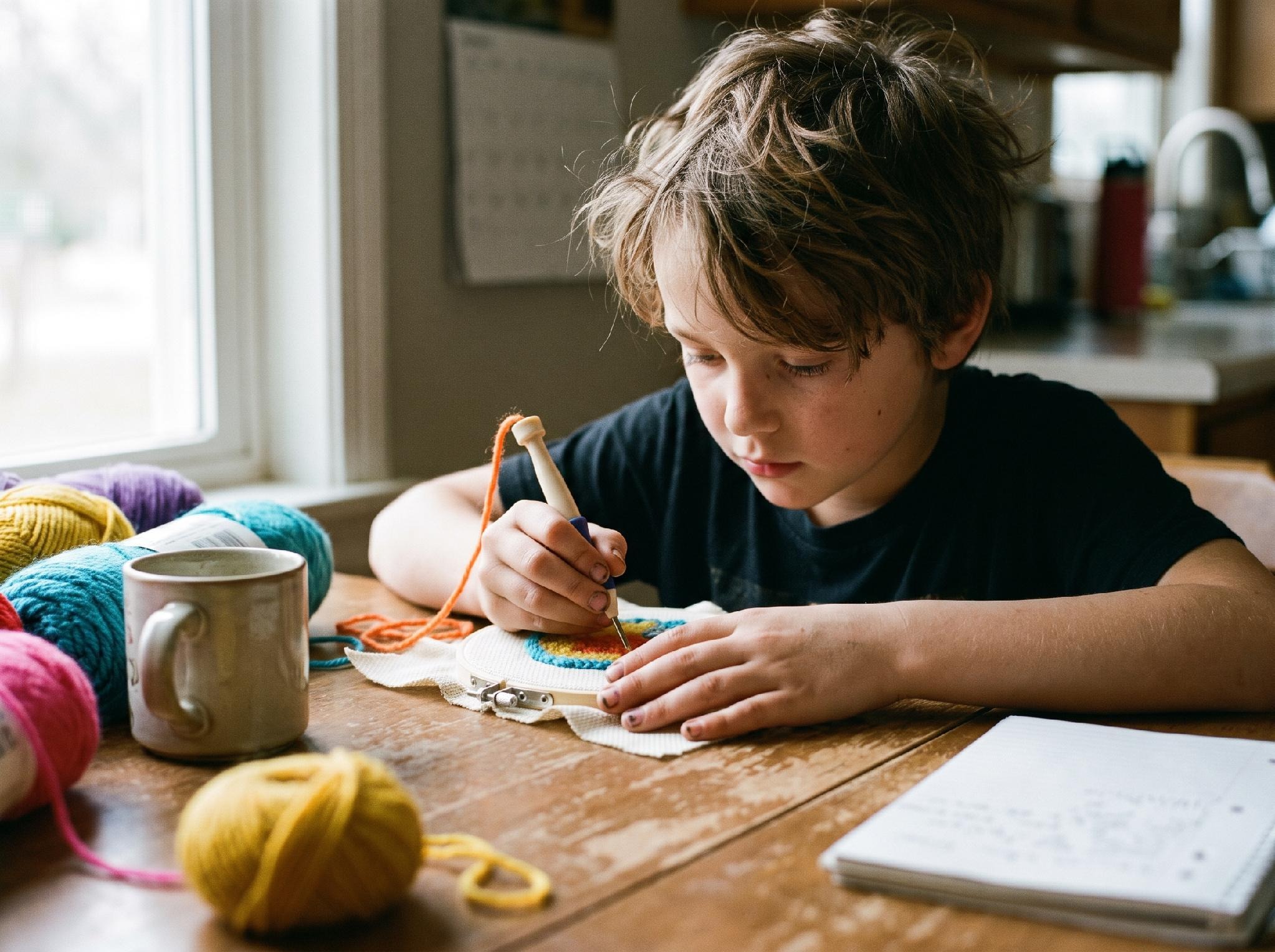
A child focused on a punch needle project instead of a screen
Getting a child to put down a tablet for a whole hour used to feel like a small miracle. These days it can feel nearly impossible. A 2025 survey from Lurie Children’s Hospital found that 49% of parents rely on screen time every day just to manage the basics of parenting, and 28% reach for a device multiple times a week to head off a meltdown. Kids aged 5 to 8 now average 3 hours and 28 minutes of screen time daily, according to data compiled by Backlinko, and even 2- to 4-year-olds are logging over 2 hours.
None of this makes anyone a bad parent. It just means the bar for a genuinely engaging screen-free activity has gotten higher. Punch needle, it turns out, clears that bar in a way few crafts do. It’s tactile, it’s fast enough to hold a short attention span, and it produces something a kid can actually hang on their wall or give as a gift. That combination is rarer than it sounds.
What Is Punch Needle, and Why Kids Take to It
Punch needle works by pushing a hollow needle loaded with yarn through a stretched piece of fabric, over and over, to build up a textured, loop-pile design. There’s no threading a needle through fabric from both sides, no knot-tying, and no prior stitching experience required. Compared to embroidery or knitting, it’s remarkably forgiving. A wobbly line still looks intentional once the loops fill in, which takes a lot of the performance anxiety out of a first project.
That forgiveness matters more than it might seem. A lot of kids’ crafts fail not because the idea is bad but because the technique is too fiddly for small hands to execute without help every thirty seconds. Punch needle sidesteps that. Once a child gets the punch-and-pull motion down, usually within the first few minutes, they can work independently, which is exactly what makes it stick. Complete beginner-ready sets, like the punch needle kits for kids, come with the needle, pre-printed fabric, and yarn already sorted, so there’s no need to make a separate trip to a craft store just to get started.
The Real Developmental Payoff: Fine Motor Skills and Focus
Fine motor skills, meaning the small, precise movements of the hands and wrists, are one of the core physical development categories the Centers for Disease Control and Prevention tracks from birth through age five in its Learn the Signs. Act Early. milestone framework. The CDC specifically recommends hands-on manipulation activities to build these skills, and punch needle is about as hands-on as crafting gets.
The repetitive punch-and-pull motion requires a child to coordinate grip pressure, angle, and depth simultaneously, dozens of times per minute. That’s a genuine workout for the small muscles that later show up in handwriting, using scissors, and even buttoning a coat. It also demands sustained visual focus on a small, specific area of fabric, which is a different kind of attention from that required by most screen-based entertainment.
Global childhood myopia rates have climbed to roughly 30% as of 2025, according to research compiled by DemandSage, a trend researchers link in part to excessive near-screen use. Swapping a phone screen for a hoop and fabric doesn’t erase that risk, but it does redirect close-up focus toward something with real developmental upside rather than a passive scroll.
Screen-Free Doesn’t Have to Mean Boring
The American Academy of Pediatrics released its first major update to screen-time guidance in a decade in 2026, and the shift is notable. Rather than focus purely on hour limits, the updated AAP guidance now emphasizes quality and context, while still recommending no more than an hour of high-quality content daily for children aged 2 to 5. That framing puts pressure on parents to find alternatives that are genuinely engaging, not just screen-free for its own sake.
This is where many well-intentioned “unplug” suggestions fall flat. Board games get abandoned after ten minutes. Coloring books lose their appeal fast. Punch needle holds up because the payoff is visible in real time. Every few punches, more of the design fills in, which keeps kids checking their progress the way they might check a game score, except the reward is a physical object they made themselves.
Getting Started Safely at Home
A few basics make the first project go smoothly, rather than turning it into a one-and-done experience. Choose a hoop between 4 and 6 inches for a first attempt. Anything larger takes too long to fill and can lose a young crafter’s interest halfway through. A pre-printed pattern, rather than a blank canvas, gives a clear target and removes the pressure of designing something from scratch. Adult supervision is worth building into the routine, not because the needle is especially dangerous, but because good habits around tool handling are worth establishing early, just as they would be for scissors or a hot glue gun.
Punch needle also pairs naturally with other needle-based crafts a child might already know. If your family has experience teaching a child a new hands-on skill, a lot of that groundwork- patience with small motor tasks, comfort holding a tool with intention- transfers directly. And if punch needle turns out to be a hit, there are plenty of simple sewing projects to try next that build on the same dexterity without requiring a big jump in difficulty.
From First Project to New Hobby
Once a child has finished one hoop, the next ones tend to come faster and with more confidence. Personalized gifts are an easy next step: a punch needle piece with a pet’s silhouette or a grandparent’s initials turns a craft session into something with real emotional weight. Seasonal designs, like a small pumpkin for autumn or a heart for February, give kids a reason to return to the craft throughout the year rather than trying it once and moving on.
For families looking to round out a rotation of screen-free options, it helps to have a small library of go-to projects rather than relying on a single craft. Our piece on creative activities that build real dexterity is a good next stop for ideas that complement punch needle without requiring new equipment.
Worth the Effort
Punch needle isn’t a miracle fix for screen time, and no single craft is. But it solves a specific, common problem: finding something that’s genuinely engaging enough to compete with a tablet, while quietly building the kind of fine motor coordination that pays off well beyond the craft table. It’s forgiving enough for a first attempt, fast enough to show progress within minutes, and flexible enough to grow into a real hobby.
For a family trying to carve out more screen-free time without a fight, that’s a rare and useful combination.